Lesson forty three. Repair the moment without surrendering the standard.
You learn to repair a sharp moment quickly by naming what you did, acknowledging its effect, restating the standard, and changing your next move.
▷ ListenLearn by listening. Audio lessons, spoken quizzes, and practical tutorials for the things we want to understand. Transcripts are there whenever you want to read along.
Subscribe to learn with meMy favorite course · Free
A short daily lesson on saying the hard thing, asking for what you need, writing that works without you, and leading people. One framework, one story, one thing to try today.
Start listeningYou learn to repair a sharp moment quickly by naming what you did, acknowledging its effect, restating the standard, and changing your next move.
▷ ListenCreate dependable books, payment controls, tax planning, legal records, privacy practices, and operating reviews that prove important work is finished.
See why some young companies use venture capital, how that bargain differs from customer revenue and debt, and why growth potential is not the same as business quality.
▷ ListenLearn how a founder connects customer value, delivery, money, and decisions. Use constraints, small experiments, and a steady review rhythm to choose the next important job.
▷ Listen
The memory model behind a fleet of always-on agents: files you can read, not an opaque pipeline — an instruction hierarchy, a relevance-recalled fact directory, and a propose-then-own boundary that keeps shared memory from rotting into a junk drawer.
Read
Claude Code's memory is the inverse of Codex's: files, not a pipeline. A hierarchy of human-readable CLAUDE.md instructions plus a model-managed memory directory. Here's how it actually works.
ReadA teardown of Codex's memory engine: two tables, a promotion gate, and a lease-based job ledger. It treats memory as a processing pipeline, not a chat log — and that's the part worth stealing.
ReadCodex treats memory as a processing pipeline; Claude Code treats it as a library of files. Same goal, opposite shapes. A head-to-head — and what a portable layer should steal from each.
Read
A practical guide to using Git worktrees so multiple AI agents can work in parallel without stepping on the canonical repo.
ReadHow to build an AI system that remembers, connects, and gets sharper over time — on any stack, on Open Brain, or self-hosted on a machine you own.
Read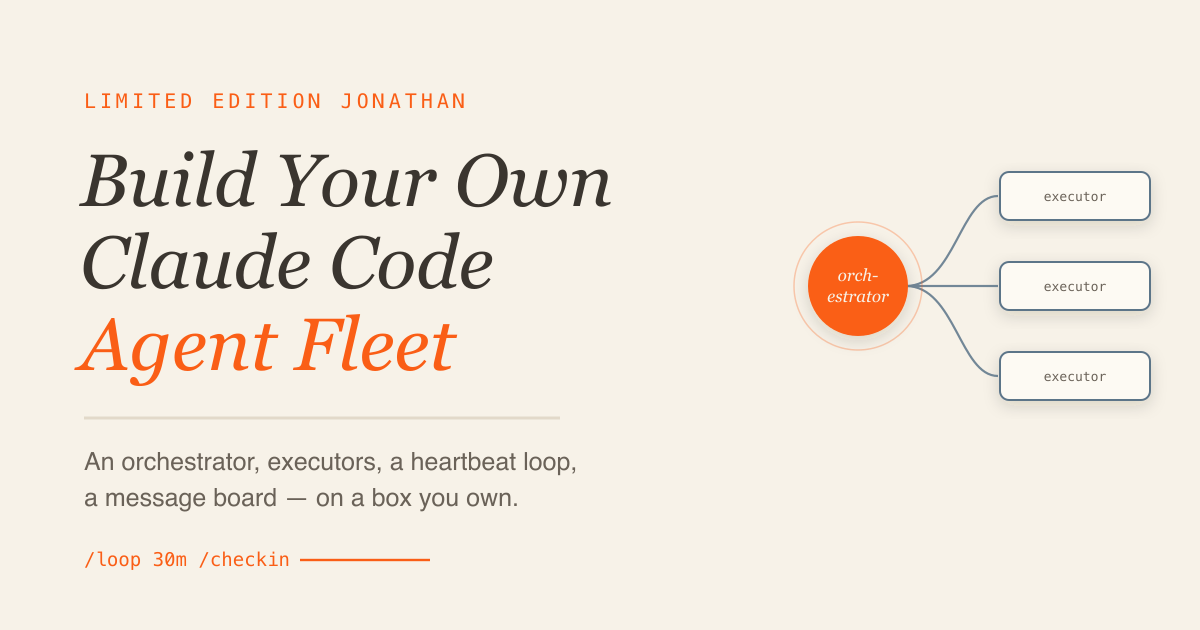
A practical blueprint for running a fleet of always-on Claude Code agents on a box you own and your own Claude subscription — an orchestrator, executors, a heartbeat loop, a message board, and memory that survives restarts.
Read
We gate our ideas before we build them — a habit inherited from an era when building was expensive. It isn't anymore. Build first; decide if it's good later.
ReadA short daily lesson on saying the hard thing, asking for what you need, writing that works without you, and leading people. One framework, one story, one thing to try today.
You learn to repair a sharp moment quickly by naming what you did, acknowledging its effect, restating the standard, and changing your next move.
▷ Listen
A practical playbook for building a repeatable image pipeline.
Copy the scaffoldTurn a one-line brief into a finished video through a reusable agent skill.
▷ WatchHeadlines, what changed, and why it matters. Find my latest takes in News Factory.
Visit the News FactoryI learn by listening. When I go deep on something, I turn what helps me understand it into lessons you can take on a walk, on a drive, or wherever you think best. Come along.
Subscribe to learn with me